top of page


Aimee Cordova Delgado


Documentary Art Portfolio
Sketchbook
These drawing assignments are weekly throughout the semester. One of the most basic and direct means of interpreting our world and our relationship to it is through drawing. Like any discipline, we all have various levels of inherent ability. Practice on technique will always improve that natural skill level to a higher degree. Drawing may have a variety of purposes, whatever that purpose happens to be, observation is at its core. Regardless of the object you are looking at, your actual subject is light. This means to take a very careful look at the shapes that are highlights and those that make up the shape of shadows first. Then, see all the countless shades of value that exist between those highlight and shadow areas.


1/6
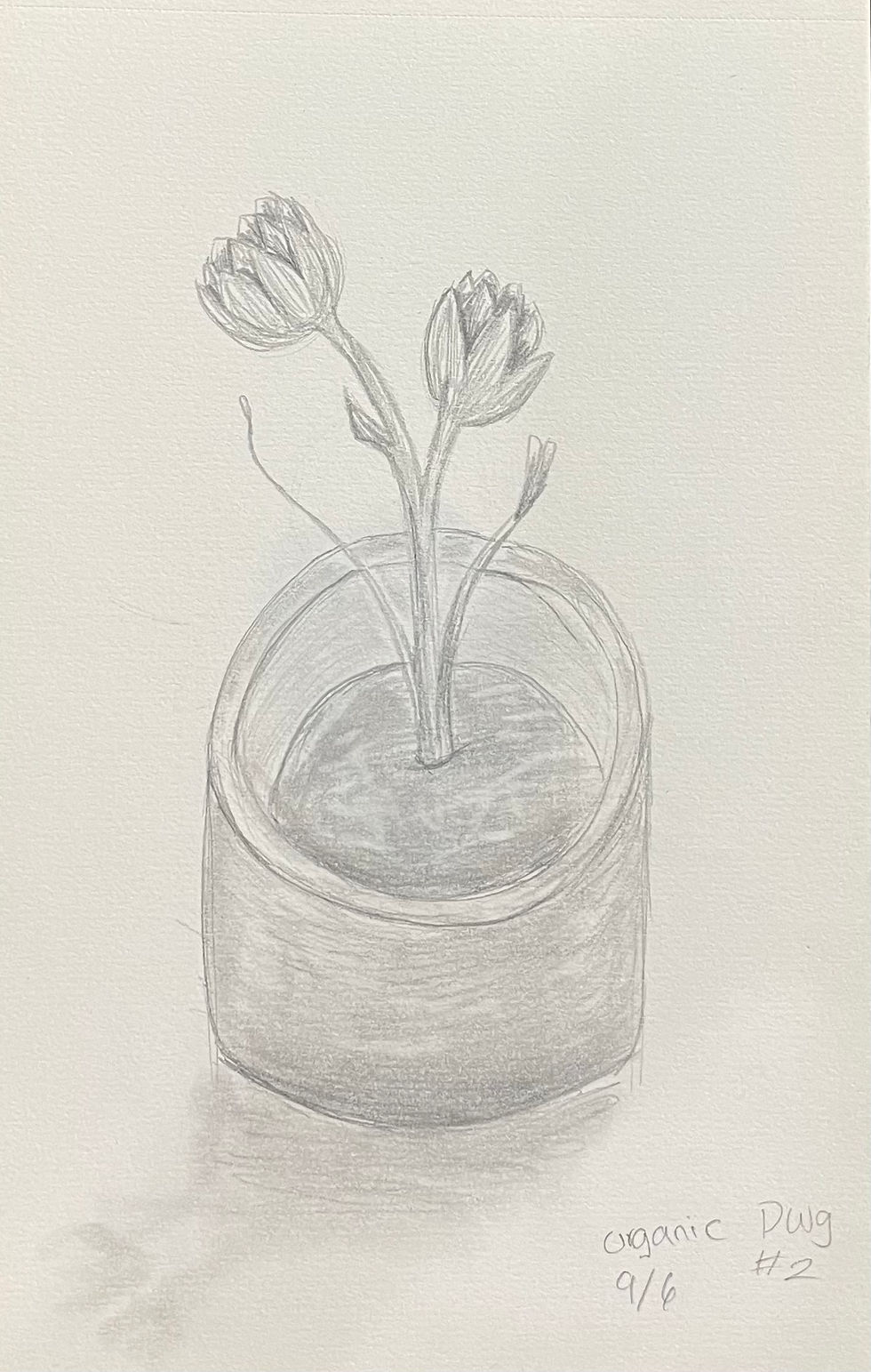
man-made & natural
Draw at least six drawings from direct observation (real things only). Three of these objects should be man-made/mechanical objects (staplers, wrenches, pliers, scissors, etc.). The other three should be organic/natural objects (fruit, veggies, trees plants, rocks, bones, etc.)
I haven't had a sketchbook or sketch, so this was an introduction to sketching. It was doing sketches of things I see daily , working with different mediums to sketch I find working with pen more fun.


1/6
animated man-made & natural
Animate each of the six objects that you drew last week. This is your opportunity to be highly creative and imaginative by giving each of the objects “life”. This does not necessarily mean to simply add legs and arms, but instead “distort” the original drawing in a way that it now looks like it could move about, or is alive. This may include arms and legs, etc. but that should not be the main aspect. (a classic animation technique, called squash and stretch is an example of doing this which you might employ this week.) Exaggeration is key to this working. The objective is to try and illustrate something in motion—the act of moving (running, skipping, jumping, crawling, etc.) This is different from simply showing how something might move (with attached wheels, propeller, legs, etc.) Think attitude.
I love animating objects however I put facial expressions so it was kinda hard animating something without personification it, nevetheless I learned how to exaggerate movement with lines.


1/7
mechanical object
Focus on one object only. A different object from any you have previously worked with. It must be something mechanical (not digital). It also must be a mechanical object that you can “take the cover off” to see how it works, the gears, the springs, the moving parts, etc. Draw these inner workings 6 different times. (examples; inside of a clock, bicycle gears, engine, motor, conveyor belt, etc.) Focus on a detailed, realistic representation of how these parts interact or connect with one another.
I haven't taken something apart and look at it closely, it was an interesting thing to do and I learned more how clocks work and even though my drawings have darker values to it I feel like I capture the details. Although there is still room for improvement.

1/1
organic object
Focus on one object only. A different object from any you have previously worked with. It must be something organic (not man-made). Objects with 3D form (examples; bones, vegetables, fruits, branches, roots, not flowers, etc.) Concentrate on shading. Make it look real.
I was eating when I decided to do a lemon for my object. I decided to cut it and put light on top however it seems that I did not capture the highlights however I did capture the shadow, cast shadow and the main light. I learned how to capture a lemon more realistic by adding a range of value.


1/6
the unnoticed everyday
Draw at least six drawings from direct observation (real things only) that you pass by each day on your way from home to class. These should be things that you normally don’t notice yet you pass by them each day without seeing them. If these objects cannot be moved from their location, plan your time accordingly so that you can spend sufficient time to slowly and carefully examine every inch of their surface. Your goal is to accurately capture a likeness of each object.
Honestly this one was one of the hardest to do so far because I am very observant when I walk around the school, however I chose some that I see everyday. I focused a lot on the light source and shadows. I really learned proportion and realism.


1/6
hands
Draw at least six hands in different positions, from direct observation Your goal is to accurately capture the “life” of each hand.
For me when I draw people hands are one of the most difficult part of the body to draw, I used my left hand as a model while I draw with the right hand. I focused on the shadows and highlight to create a more realistic hand.


1/6
noses
Draw at least six noses in different positions, from direct observation Your goal is to accurately capture the “life” of each nose.
This is another body part that I have difficult drawing realistic, because sometimes it didn't fit the frame of the face or I made the nose big or small. For this sketch I used my l took pictures of my nose and draw it. I focused on the shadows and highlight to create a more realistic nose.


1/6
faces
Draw at least six heads/faces in different positions, from direct observation Your goal is to accurately capture the “life” of each heads/faces.
For this week I used google to find dramatic facial expressions. it was fun drawing this and even though I didn't use value or shading I try to make them realistic by sighting and having the correct proportions of the face.


1/6
eyes
Draw at least six eyes in different positions, from direct observation Your goal is to accurately capture the “life” of each eye.
This sketches were kinda easier and more fun for me because one body part that I liked drawing the most are eyes (I have drawn eyes before). I used my own eyes as the model, I took photos in dramatic lighting and different positions. I focused on sighting and value to make the eyes more realistic.


1/6
heads
Draw at least six MORE heads/faces in different positions, from direct observation Your goal is to accurately capture the “life” of each heads/faces.
For this week I used google to find different head positions. Even though I didn't use value or shading I try to focused on having the correct proportions of the head. I learned a lot from this week. It was kinda hard to do the head position this one of the things I struggle when it comes to draw people in action.
Comments
Share Your ThoughtsBe the first to write a comment.
bottom of page